

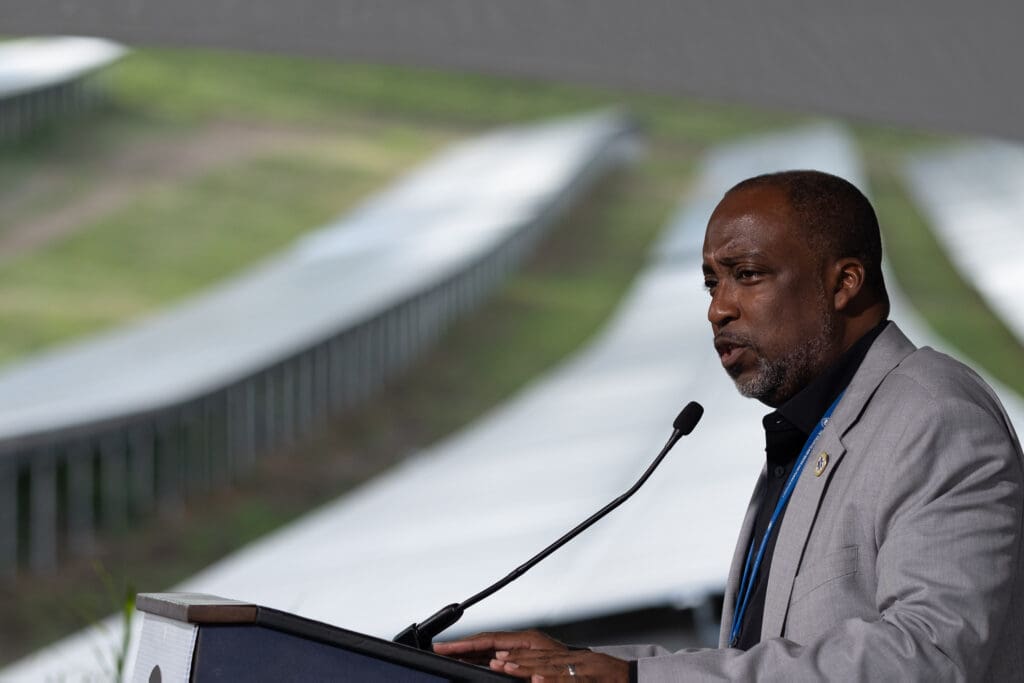
When Karl Knight assumed the role of chief executive officer of the Virgin Islands Water and Power Authority in late July 2024, he inherited a utility beset with challenges: financial instability, operational inefficiencies, and a legacy of public distrust. In an interview with the Source Wednesday, Knight reflected on his initial months in office, detailing the strategies he’s employed to stabilize WAPA and set it on a more sustainable path.
On Wednesday, Knight said one of his immediate priorities was to address leadership vacancies that had left key positions unfilled for extended periods. The chief financial officer role, for example, had been vacant since December 2023, with Lorraine Kelly serving in an acting capacity for nearly a year before her permanent appointment in December 2024. Similarly, the chief operating officer position had been held on an interim basis since 2022 until Lemuel Lavinier’s appointment in late 2024. Lavinier started officially this month.
These positions had been critical in addressing systemic inefficiencies and ensuring continuity in WAPA’s operations.
But the leadership appointments have also not been without controversy. Knight’s tenure also saw the resignation of Ashley Bryan, who had been serving as interim chief operating officer for electric systems. Bryan, a veteran with over a decade at WAPA, stepped down in November 2024, citing personal reasons. Her departure came at a time when the utility was undergoing significant transitions, and her role was pivotal during periods of operational instability.
Meanwhile, in November 2024, Anthony Thomas was appointed as WAPA’s chief administrative officer. Thomas previously served as commissioner of the Property and Procurement Department from 2019 to 2023, overseeing asset management, contracting, procurement, and fleet operations for the government of the Virgin Islands. Prior to his government service, Thomas held the position of vice president at Mon Ethos Pro Support, a cybersecurity firm involved in a federal investigation after its founder, David Whitaker, pleaded guilty to wire fraud and bribery charges.
While Thomas was not implicated in the scandal, his association with the firm has drawn public scrutiny. Knight addressed those concerns Wednesday, focusing on Thomas’ procurement experience.
Reflecting on the leadership shifts, Knight also spoke generally about the complexities of such decisions. “Leadership changes are never easy, but they are necessary to align with our long-term goals,” he said, emphasizing his commitment to fostering stability within WAPA’s executive team. Critics have questioned whether new hires can overcome systemic inefficiencies quickly enough to meet the public’s expectations. Knight also acknowledged the skepticism but underscored the importance of having a stable, qualified team to execute WAPA’s strategic goals. “We’ve made decisions that reflect the long-term interests of the utility and the community,” he said.
“My preference is always to build from within,” Knight added. “When that’s not available, the next best thing is to bring in individuals with familiarity and ties to the region who can understand our unique challenges.” This philosophy also guided the appointment of Lavinier, who has ties to the Caribbean and a deep understanding of the region’s energy landscape, Knight said.
Questions have remained, too, about Knight’s pay package and his move from Gov. Albert Bryan Jr’s chief of staff. On Wednesday, Knight said his compensation package includes a base salary of $300,000, with an optional $36,000 housing allowance, which he has declined. It also includes a $75,000 discretionary bonus, which Knight will be awarded prior to the end of the fiscal year June 30, based on milestones to be determined by WAPA’s board. The contract is for three years.
In contrast, his predecessor, Andy Smith, had a base salary of $325,000, along with additional allowances – relocation at $40,000, housing at $45,000, and a “safety bonus” of $30,000 among them.
Keeping the Lights On
Knight underscored a milestone in his tenure so far has been the resolution of disputes surrounding the installation of four new Wartsila generators at the Randolph Harley Power Plant on St. Thomas. The project had been stalled due to financial disagreements, particularly change orders, with work halted as recently as 10 months ago.
Through negotiations, WAPA resolved a $15 million payment dispute by agreeing to a reduced settlement of $5 million and incentivizing the contractors with an additional $2 million to complete the project ahead of the revised schedule. Knight said the approach proved successful, and the generators were commissioned on time. Knight credited Adrianne Todman, acting secretary of the U.S. Housing and Urban Development Department, for her critical support in facilitating access to federal resources during this process. Todman, a V.I. native, will be on St. Thomas Friday for the official commissioning of the generators; her visit, according to Knight, underscores the collaborative efforts between federal agencies and local utilities to improve community resilience and development.
As the Biden administration prepares to transition out of the U.S. presidential office with the inauguration of Donald Trump Jan. 20, this visit may mark Todman’s final trip to the territory in her current capacity.
“Her understanding and advocacy at the highest levels made a significant difference,” Knight said. “I’m honored to have her backing and to showcase these accomplishments during what may be her last visit home in her current role.”
Knight has also prioritized renewable energy projects as part of WAPA’s broader strategy to diversify energy sources and reduce reliance on imported fossil fuels, he said. A major step in this direction is the operational Petronella Solar Farm on St. Croix, which began generating over 10 megawatts of power in December 2024. The project is designed to integrate battery storage, which stores excess power and stabilizes the grid during cloudy conditions or peak demand periods. Meanwhile, construction is underway for another solar farm in Estate Hogensborg, expected to add 11 megawatts of renewable capacity upon completion, Knight said.
“Our approach to renewable energy isn’t just about climate consciousness,” Knight said. “It’s about economic resilience and creating a more reliable energy grid for our community.”
Despite the steps forward, WAPA continues to face financial challenges. The utility’s debt and operational inefficiencies have led to service disruptions, among them rotational power outages due to fuel shortages. On Wednesday, Knight said WAPA is in the process of renegotiating with fuel supplies and has a Request for Proposals out to explore the liquefied propane gas market with a supplier outside of Vitol.
Meanwhile, as WAPA transitions out of a prolonged energy state of emergency, the onus is on Knight and his leadership team to maintain energy stability and address public concerns without extraordinary government intervention.
Billing issues have also been a persistent challenge for WAPA, with widespread complaints about inaccurate estimates and malfunctioning meters. Knight said he has been focused on initiating efforts to replace over 1,000 faulty meters in the past month and securing an additional 5,000 units to modernize the system. He also said that estimated billing cannot be eliminated entirely but emphasized that the goal is to significantly reduce its reliance by the summer.
“We understand how critical this issue is for our customers,” Knight said. “Restoring trust and transparency in our billing practices is a fundamental part of rebuilding this utility.”