

“Wait for me I’m coming
In my garters and pearls
With what melody did you
barter me from the
wicked underworld?”
—Anaïs Mitchell
Young, destitute and tragically romantic, the penniless poet Orpheus is tasked with composing a melody so beautiful it will both induce the arrival of spring and persuade Hades to release Eurydice from the fiery clutches of the Underworld.
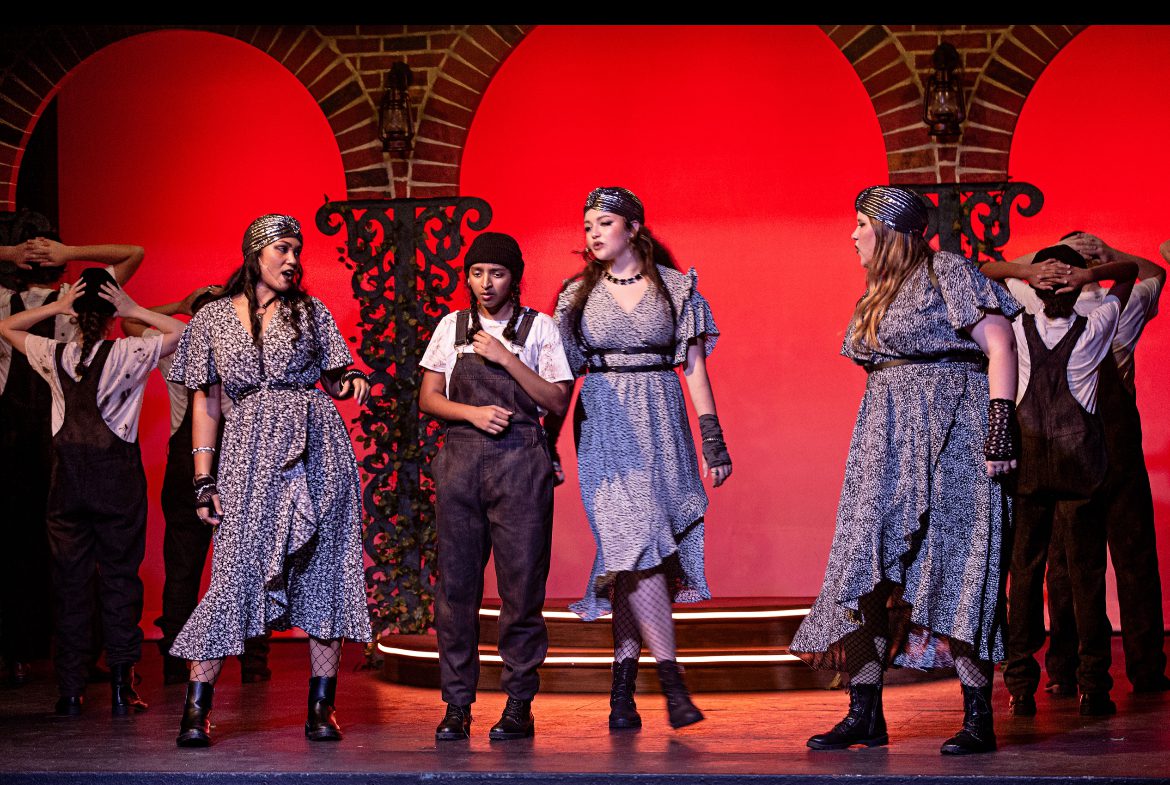
The chips are down in the mortal world above, where the climate is unstable, poverty is rife, and economic recession spreads like a plague over the land. Falling prey to a Faustian bargain in which Hades promises her relief from poverty and hardship, Eurydice is lured into forsaking her love for Orpheus and joining Hades in his underground lair, which takes the form of a postapocalyptic walled factory in which faceless workers toil tirelessly like automaton cogs in a profit-churning industrial nightmare. Welcome to Hadestown! When Orpheus learns that Eurydice has been abducted by Hades and lured into the underworld, he sets out upon an epic journey on the road to hell, determined to rescue his young lover with a song.
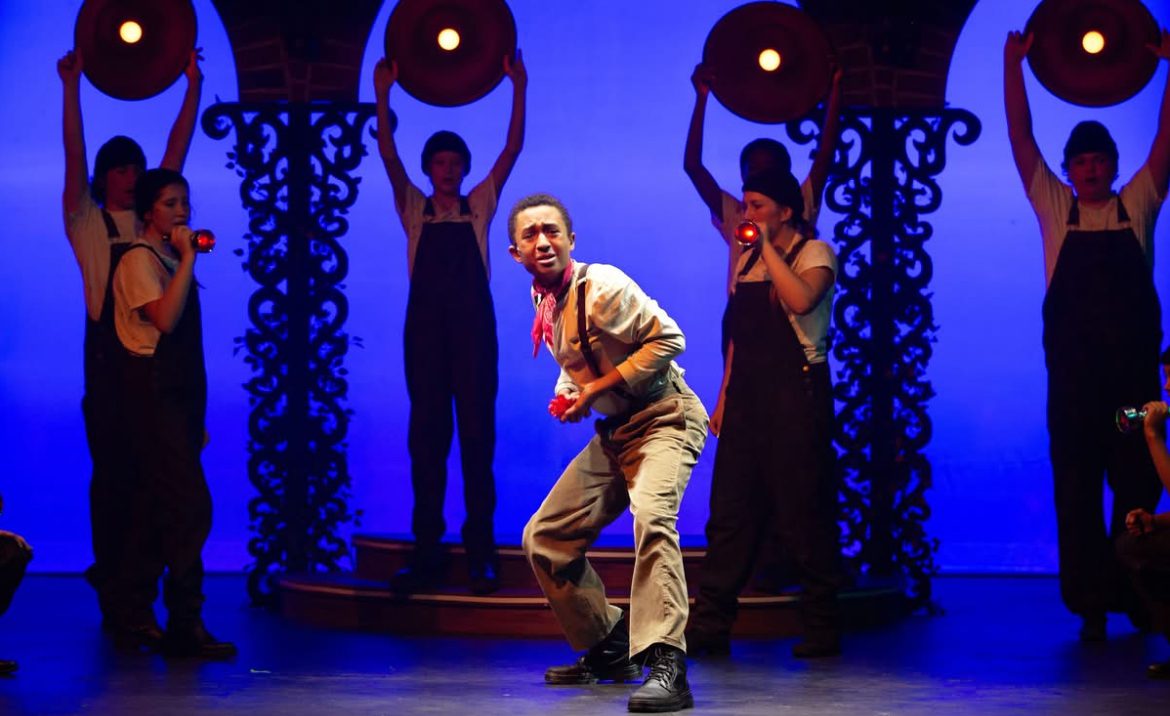
The show opens with the messenger god Hermes, whose vocal narration of “Road to Hell” helps set the stage for all to come by introducing the musical’s cast of Gods and mortals and reminding the audience that what they are about to witness is an “old song, an old tale from way back when.” But who knew Hermes was Crucian? In the hands of 11th grader Kimaya Jackson, who plays the role marvelously, this myth becomes fact and her Crucian-inflected portrayal of the messenger god shines a bright light on the inherent music, color and poetry of the local dialect.
In “Road to Hell,” the cast promptly breaches the 4th wall with a hypnotic opening refrain, a bluesy minor pentatonic riff set to the rhythmic pulse of the railroad to the underworld, which draws the audience into a call and response, setting up a repetitive incantatory hum that seems to signal a spell is being cast. Caught up in the rhythmic hypnosis, players and audience alike enter the timeless dimension of myth, a spell that lasts for the duration of the show.
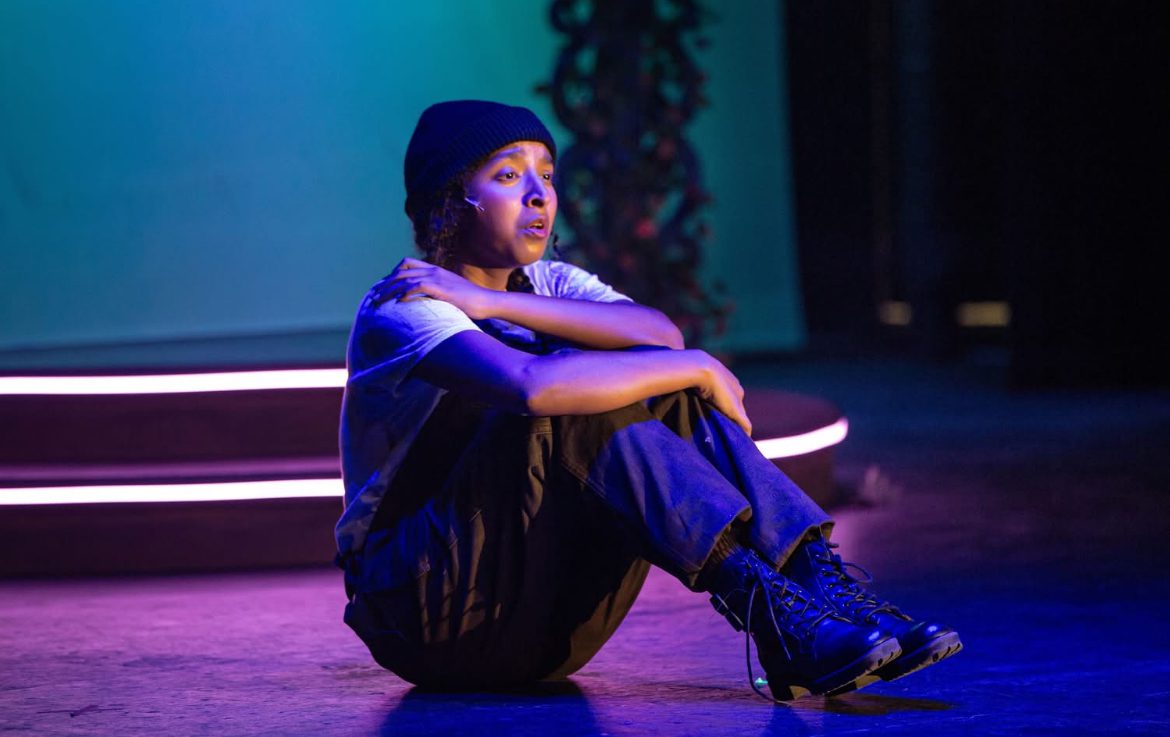
Sitting in the darkened theater watching the unfolding spectacle of Orpheus’ epic journey into the underworld propelled by an electrifying Gumbo of jazz, blues, Dixieland and folk, I found myself thinking of the great mythologist Joseph Campbell, whose approach to myth and story has had a shaping impact on my own teaching of literature in high school. Answering the clarion call to adventure by his love for Eurydice and his determination to save her, Orpheus casts aside his own safety and comfort and willingly faces the perils and challenges of a harrowing descent into the Underworld. His story contains all of the elements of that universal, cyclical narrative template that Campbell referred to as “The Hero’s Journey.”
Campbell believed that the role of the contemporary artist is to reimagine the universal mythic archetypes of the past and to reinterpret them in terms of the modern moment. In his novel Ulysses, for example, James Joyce famously retells Homer’s Odyssey, but distills that decade-long saga into a single day in the life of a character named Leopold Bloom and sets it on the stage of the streets in Dublin in 1904. Vermont-based singer-songwriter turned playwright AnaïsMitchell seemed to be doing something similar with Hadestown. Utilizing the tropes of ancient Greek myth to comment on the contemporary moment, she playfully intertwines the myths of Orpheus, Eurydice, Hades, Persephone, Hermes, and the Fates, inviting those mythic characters into the present to renew an old song, an ancient tale about trust, faith, love, doubt and the transcendent power of the creative act to restore order to the world.
Living in a preindustrial world, the ancient Greeks were blissfully untroubled by the specter of global climate change, which today has become an existential threat that is increasingly in the foreground of our social and political discourse. In Hadestown, drastic shifts and unpredictable patterns in the weather stem from the turbulent and troubled marriage between Hades and Persephone. In the original story, Hades abducts Persephone, absconding with her into the Underworld, which causes winter in the mortal world, but he allows her a reunion with her mother, Demeter, every spring. Upon her return, the temperature warms, flowers blossom and renewal spreads over the landscape. It was a myth that provided an explanation for seasonal change in the ancient Greek world.
In “Any Way the Wind Blows,” young, hungry and on the run, Eurydice mourns that “the weather ain’t the way it was before,” and obliquely describes a world transfigured by climate change: “ain’t no spring or fall at all any more. It’s either blazing hot or freezing cold.” In the universe of the musical, these drastic shifts in the weather are a result of marital strife and Hades’s insistence on keeping Persephone in the Underworld for longer and longer periods of time, leading to more death and decay in the living world.
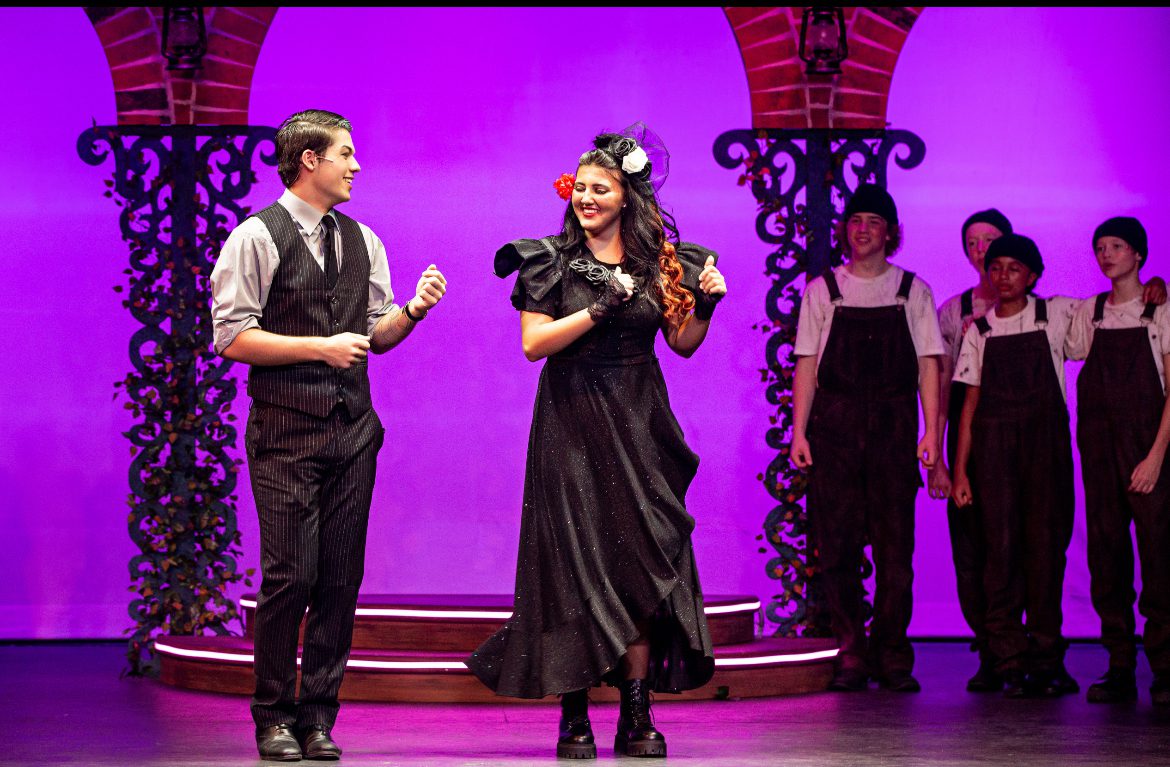
Lady Persephone, goddess of the seasons, the “cycle of the seed and the sickle,” is cast as an irrepressible force of nature: sassy, saucy and spirited (as well as something of a conspicuous boozehound!) The part is played pitch-perfectly by 11th-grader Peyton Schindler, whose performance provides the perfect counterpoint to the fiery, toxic masculinity of Hades, a role that 11th-grader Tristan Samuel delivers with gusto in a starched suit, dark glasses, and perfect hair.
In classical Greek mythology, the Three Fates or “Morai” personify destiny and control the proverbial thread of life for all mortals. In Hadestown, the three sisters function as the embodiment or personification of characters’ internal dialogue, that voice in the back of one’s mind, specifically as whispers of fear, self-doubt, and bitter recrimination in the minds of Orpheus and Eurydice. Performing in these roles, 10th grader Lena Kammerzelt and 12th graders Amalie-Laeah Figueroa and Allegra Ferreras provide the show with some of its best moments and the seamless three-part harmony they manage as they mock, cajole and sow doubt in the minds of the young lovers is especially impressive.
Having survived the descent into the underworld, Orpheus arrives in Hadestown and is reunited with Persephone. In confronting Hades, Orpheus appeals to the humanity he senses beneath that sinister exterior and finds common ground by drawing parallels between Hades’ love of Persephone and his own love for Eurydice. Orpheus then sings his song, presenting a melody that has developed and evolved as a subtle motif woven into the background of the musical over the course of the show before rising to center stage as a crescendo in this performance before Hades.

Orpheus’ performance is so moving, his melody so full of beauty and pathos, that it convinces Hades to allow Eurydice to return with him to the living world. As in the original myth, however, Hades tests Orpheus’ faith with a single condition: on their ascent back to the living world, Eurydice must trail behind Orpheus and not be at his side until they emerge into the sunlight of the world above. During the journey, Orpheus is never to look back to ensure that Eurydice is following him, or else …
During their ascent, the Fates play upon Orpheus’ insecurities and pester him with persistent whispers of self-doubt. As the young lovers near the surface, suddenly overcome with doubt, Orpheus cannot resist the impulse to look back at Eurydice, who is then abruptly drawn back into the fiery depths of the Underworld, lost to Orpheus forever.
Despite recalling Hermes’ reminder in the show opener that “It’s an old tale and we all know how it ends,” the moment seems to come as a shock. It reveals that doubt itself is, in fact, the tragic tale’s true villain, not Hades after all. In the omniscient wisdom that is Hermes’ hallmark, we are told:
The dog you really go to dread
Is that one that howls inside your head
It’s him whose howling drives men mad
And a mind to its undoing
But the last we see of Orpheus, who is played with astonishing skill and charisma by 9th grader Avery Adams, and Eurydice, played with equal grace and talent by 12th grader Maya Prasad, returns the young couple to the moment of their first meeting in the mortal world when she is taking shelter from the cold and he is working on a song to bring back spring. The musical has come full circle and like the arrival of spring in the cycle of the seasons that Persephone represents, the stage is set for another go around! And once again, whether ill-fated or not, hope stubbornly springs eternal anew!
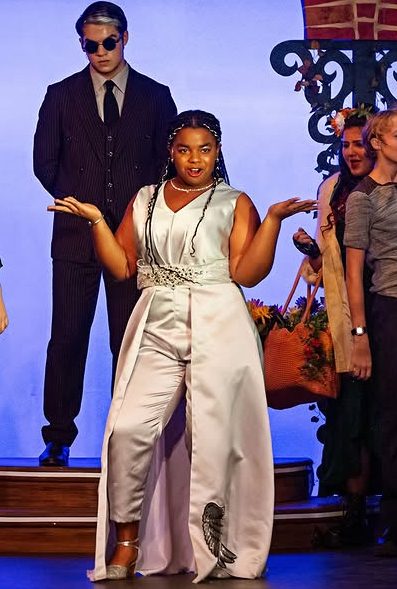
(Photo courtesy GHCDS)
GHCDS’s long-standing dedication to the theatrical arts and its commitment to excellence in drama shone through every aspect of the performance. Sitting in the darkened theater and beaming with pride while watching so many of my former students bring the mythic past alive in the present through the vehicle of Anais Mitchell’s musical Hadestown was actually a familiar experience. As an English teacher in the high school at GHCDS for over a decade, I always relished seeing my students perform in the fall dramas and spring musicals. It was thrilling to watch them thriving in a context outside the classroom and to witness their latent talents come to fruition in the convivial, community setting of shared performance. I came to believe that the drama program’s performances presented a kind of distillation of everything the school and the community do well, and these performances offered an opportunity to celebrate together and, in the parlance of Hadestown, to “live it up on top!”
Just when you thought the GHCDS theater program had outdone itself, at the moment I’m recalling The Drowsy Chaperone (2017), and Mama Mia (2019), they come forward with an astonishment like Hadestown (2026). What a gift to the larger community of the Virgin Islands these vibrant performances are. And it should be noted that the new incoming head of school, a proud native Crucian and graduate of Good Hope School, Mr. Ali Morgan, is himself a student of the theater arts and shares this commitment to excellence in drama and so I’m guessing we can look forward to more tastes of “Broadway on St. Croix” in the years to come.
I appreciate whatever mysterious force precipitated the arrival upon our shores of those mythic figures from the deep past and induced the likes of Orpheus and Eurydice, Persephone and Hades, Hermes and the Fates to wash up on St. Croix, take the stage at Good Hope Country Day School and breathe new life into an “old song” for spellbound audiences. I remain in awe of the cast and crew that produced the astonishment that transpired on the stage the night I saw the show. While the musical was entirely student-driven and student-executed, from cast to crew, from start to end, those who helped the students shepherd the production into existence also should come forward, take a bow and receive a standing ovation: Kiomie Pedrini and Carolyn Forno codirected Hadestown, Yoav Hayut was its Musical Director, Joseph Barnwell was its Technical Director and alumna Cereyna Bougouneau (GHCDS class of 2016) was its Choreographer.
As I suspect was true of everyone in attendance, I walked out of the theater after the performance that night feeling as though I had been touched by the Gods.
Editor’s Note: Opinion articles do not represent the views of the Virgin Islands Source newsroom and are the sole expressed opinion of the writer. Submissions can be made to visource@gmail.com.