

The Virgin Islands Public Officials Compensation Commission, established by Act 7878 in 2015 and amended in 2020 via Act 8384, was constituted in 2020 with nine appointees: three named by the Senate President, three by the V.I. Supreme Court Chief Justice, and three by the Governor for a term of four years. Act. No. 7878 stipulated that the Governor shall convene a Commission to conduct a review of the salaries, expenses, allowances, and other emoluments of the Governor, Lieutenant Governor, members of the Governor’s Cabinet, including the Attorney General, and all Commissioners and Directors of Government agencies; Judicial Officers; Senators of the Legislature; and the Inspector General of the Virgin Islands to determine and provide pay levels appropriate for the duties and responsibilities of the respective offices and positions.

The Commission was supposed to conduct interviews, hold hearings, conduct studies, and then make a report by May 2022. However, the Commission missed the deadline by two years, due to delays in hiring a consulting firm. Because the Legislature did not act within 90 days of receipt of the Commission’s final reports, its recommendations automatically took effect. Procedurally, the President of the 35th V.I. Legislature claims not to have seen the email transmission, but there was proof of email transmission, albeit with no acknowledgment. Legally, the Commission seems to have been improperly constituted; one member was a decade-old employee of the Government Employees’ Retirement System (GERS) when the law states that no commission member should be an employee of the government, the court system, or any semi-autonomous agency affiliated with the government. Moreover, the Governor offered the commission chair a senior government position, the same Governor who directly benefited from the salary recommendation of the Commission, when Commission members are supposed to be barred from accepting positions with the government for two years after their term on the Commission ends.
However, despite the apparent procedural snafus and legal/ethical violations in the Commission’s composition and operation, the statistical analysis and calculations performed by the hired consultant firm seem opaque, unfathomable, and completely ignorant of the economic and fiscal state of the Virgin Islands. If simple objective analyses were performed, an inappropriate recommendation for a salary increase of 28% or $42,088 for the Governor would not have been made.
Numerous factors come to mind when determining a governor’s salary increase. They are listed and explained below.
1. Cost of Living
The cost of living varies across U.S. states and territories, and a governor’s salary should be sufficient to maintain a reasonable standard of living. In the USVI, the cost of living is higher, roughly comparable to Washington, D.C. and Hawaii, but with average salaries much lower than those places. In 2021, the median household income was $40,408, meaning the current Governor’s previous salary of $150,000 was 3.6 times more, which should be more than sufficient to cover typical living costs, especially given that the Governor enjoys housing, food, and travel subsidies in addition to salary.
2. Comparable Governor Salaries
Comparing the Governor’s salary to those in other states and territories can help ensure competitiveness and fairness. States and territories with similar populations, economies, and responsibilities should be benchmarks. The comparator jurisdictions to the USVI would be the other four insular territories: American Samoa, Guam, the Commonwealth of the Northern Mariana Islands, Puerto Rico, and the insular state of Hawaii. All U.S. insular territories and Hawaii are tourism-dependent, except American Samoa. All are import-dependent, face high transportation costs, have large public sectors, and depend heavily on federal transfers.
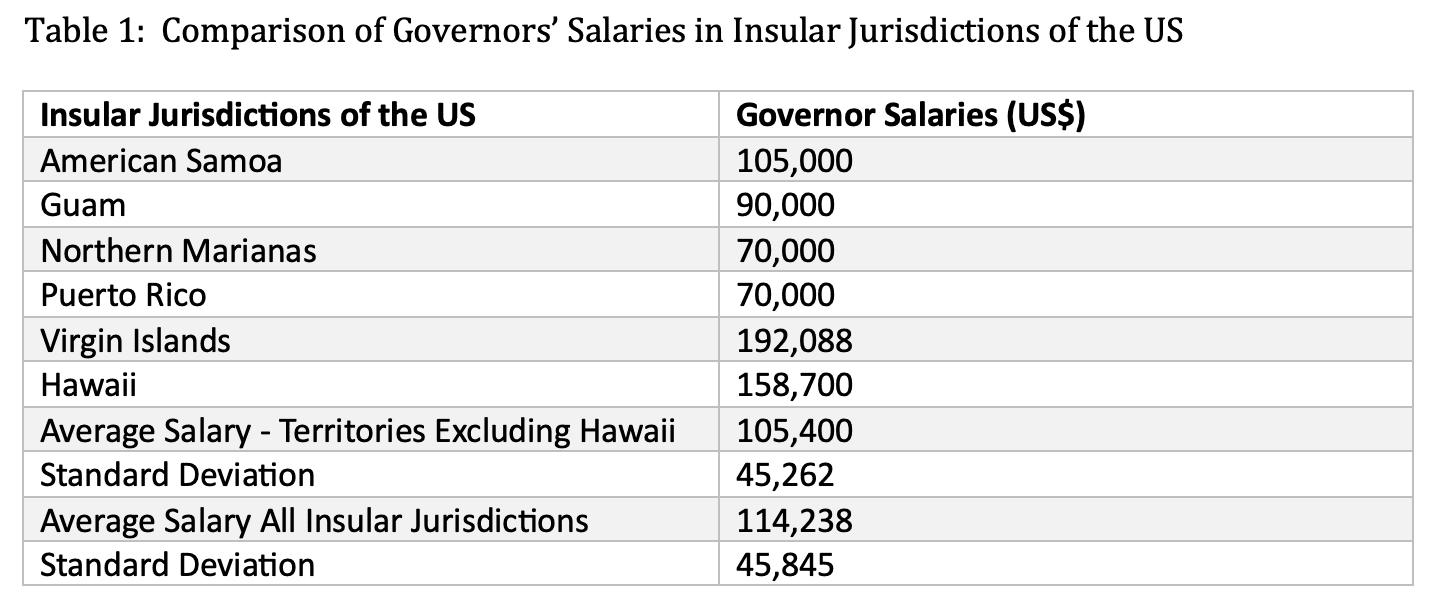
As can be seen in Table 1, the salary of the Governor of the USVI, at $150,000, was only surpassed by the state of Hawaii, an insular jurisdiction with a population of 1.4 million, a GDP of $67 billion, and annual average tourist arrivals of 9.6 million as of 2024. The USVI has a population of 87,146, a GDP of $4.6 billion (2022), and tourist arrivals of 2.6 million in the same year. With the raise to $192,088, the USVI governor’s salary surpasses all the other insular jurisdictions. It is close to 2 standard deviations above the average of the salaries of insular governors, $114,000.
3. State Budget and Fiscal Health
Tax revenue in the USVI has been experiencing anemic and volatile growth over time (less than two percent), and the Territory has faced recurrent operational deficits since 2007. Government agencies tend to be underfunded, face critical skill labor shortages, and underperform in service delivery to the public. The Central government faces over $65 million in unpaid vendor bills, unpaid tax returns, and overdue retroactive pay liabilities to government workers, has a below-investment-grade bond rating, and is heavily dependent on Federal transfers. As a result, the public perception of the Territory’s public financial management is poor, and raising the Governor’s salary would seem insensitive.
4. Attracting Qualified Candidates
Beyond doubt, a competitive salary is necessary to attract and qualify individuals for the position of Governor and to compensate adequately for the high demands of the office and associated stress. If the salary is too low, it may deter talented candidates from running for office. The Governor is comparable to a CEO in the private sector. However, the private sector in the USVI is very small, undeveloped, and unsophisticated. There are a few large and complex corporations. Seventy or so EDC beneficiary companies pay the best, along with a few financial, legal, and insurance service firms, and a handful of large hotels. Senior business leaders in the private sector are estimated to earn between $120,000 and $250,000, far below typical metropolitan areas on the U.S. mainland. Thus, the Commission would have been hard-pressed to argue that a salary of $150,000 is uncompetitive.
5. Frequency of Adjustments
An adjustment would be justified if the Governor’s salary has been unchanged for an extended period. At the same time, duties and responsibilities have expanded, and inflation has been moderate to high. The Governor’s salary changed in the USVI in 1990, 2007, and 2019. Since the last change was from $135,000 to 150,000 in 2019, it would be hard for the Commission to justify a substantial change in five years. All governors of the insular territories have been facing disaster recovery responsibilities and coping with various external shocks. Since 1990, cyclone/hurricane strikes have increased in the Caribbean and Pacific Basins. All U.S. governors faced the 2020-2023 COVID pandemic.
6. Public Opinion and Political Climate
The Commission should have considered public opinion on the Governor’s performance and the appropriateness of a salary. If the Governor is widely seen as effective, the public may be more supportive of a raise. If the Governor is ineffective, then the public and the legislature may be unsupportive of a governor’s salary increase, especially a substantial one. It is unclear if the Commission had any public hearings to gauge public opinion on the Governor’s performance and whether an increase would be merited based on performance metrics.
7. Perception of Fairness
The Commission should have rationalized any salary increase to avoid the perception of self-dealing or excessive compensation. Transparency in the decision-making process is crucial. The final report has been made public but there was no vetting and analysis of the report and the methodology used to derive the new proposed structure of salaries.
8. Long-Term Costs Impact
The Commission did not seem to consider the legacy costs of a massive increase in salary and pension liabilities on the budget. Increasing the Governor’s salary substantially will have long-term implications for the Territory’s budget and revenue generation capabilities. It is unclear if the combined cost of housing, food allowance, and travel were factored into the total compensation package.
9. Legal and Constitutional Constraints
In many states, salary increases for governors cannot take effect during their current term to avoid conflicts of interest. In the case of the USVI, having the same Governor receive two salary increases over two terms would seem unbecoming and self-dealing.
Statistical Analysis
The Commission’s salary proposals seemed to lack a justified and objective basis, so I gathered data on six variables for all 50 U.S. states and five insular, unincorporated territories, built a multivariate regression model, and, based on the regression model, estimated the Governor’s salary.
The model regressed the following independent variables — median income from the 2020 Census; GDP per capita 2022 from the Bureau of Economic Analysis: Size of the State or Territorial budgets in 2024; Public Sector Employment; Log of Fiscal Stability Ranking based on U.S. News and World Report 2025; and Cost of Living Index generated from Claude AI with imputations for the five insular territories — on the dependent variable, Governor’s salary in 2025.
The model was developed based on factors that should explain government salary variations and closely follow the determinative factors discussed above. The higher the median income, the more one would expect a broader share of equity and shared prosperity, and the Governor’s salary would be positively correlated. The higher the GDP per capita, the higher one would expect a higher overall development and growth and a commensurately higher level of the Governor’s salary. The larger the state or territorial budget, the more likely it is that the public sector is relatively more dominant in the economy than the private sector, and that the Governor’s salary would be higher since they have more demanding managerial responsibilities. In contrast, the log of a ranking of states on fiscal stability measures and the cost-of-living index is likely negatively related to the Governor’s salary. Governors are not expected to be rewarded for poor fiscal management and upward inflationary pressures.
The regression coefficient of determination (R-squared), a measure of how much variance in the model was explained by the independent variables, was a moderately good fit of the data at 38 percent. An R-squared greater than .5 would have been considered strong, and less than .30 would have been considered weak. However, three of the five independent variables had significant coefficient correlations of the right sign, and there were no collinearity or autocorrelation problems.
When the estimated coefficients were used to predict the USVI governor’s salary, it was $121,735. In other words, the Governor’s salary of $150,000 as of 2024 was unwarranted when the Commission submitted its report, and the V.I. Public Officials Compensation Commission’s recommendation of $192,088 was wholly unjustified.
On Wednesday, June 4, the 36th V.I. Legislature voted 14-0 to rescind the salaries of the Governor and other top officials. The vote was correct. The problem is that simple data gathering, economic reading, and objective statistical analysis of approximately 35 hours would have led to a more informed decision and avoided this political controversy. Why did the V.I. Public Officials Compensation Commission fail? As a community, we will need better performance from all government entities and even ostensibly government-appointed independent bodies in the Territory. The consultant firm hired seemed to have just come up with numbers that would please the political elite, and there were no technical skills or sense of independence on the Commission to evaluate and challenge the consultants.
Looking to the future, we can expect that the Governor will veto the bill of June 4, his veto will then be overridden, and he may enter court challenges to the veto. Time and resources will be wasted, but reason, fairness, and the rule of law should prevail.
— Mark Wenner is an assistant professor of economics at the University of the Virgin Islands who resides on St. Thomas.
Editor’s Note: Opinion articles do not represent the views of the Virgin Islands Source newsroom and are the sole expressed opinion of the writer. Submissions can be made to visource@gmail.com.