

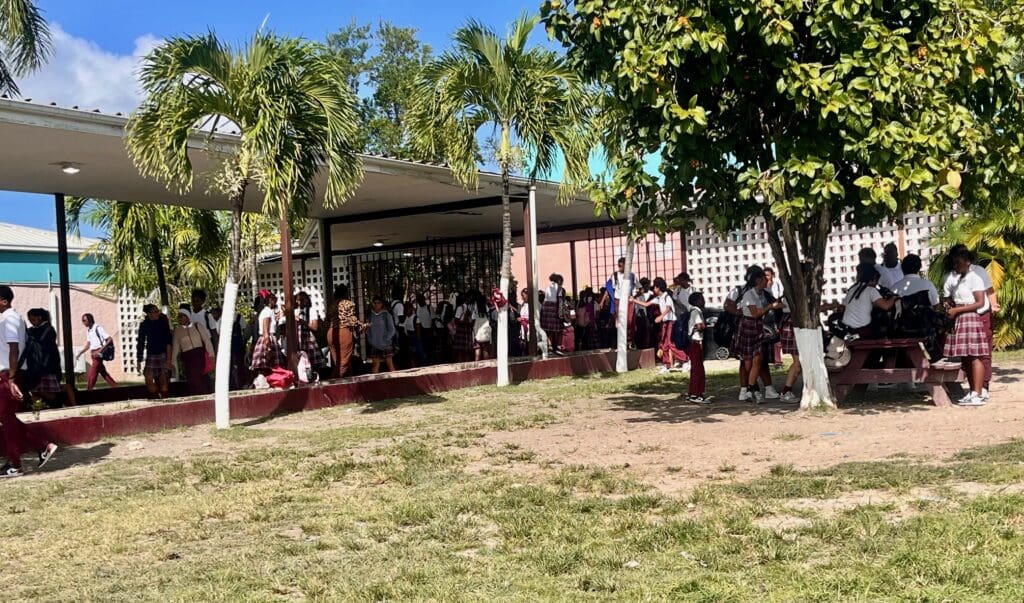
In a virtual meeting with more than 100 John H. Woodson Jr. High families, school leaders, and education officials Tuesday, Bureau of School Construction and Maintenance Director Craig Benjamin set a late-August reopening target for the St. Croix campus as crews finish a large-scale mold remediation and testing.
The school has been shuttered for the summer to allow for roof work and other repairs, but Benjamin said when Woodson’s administrators recently went in to prep the campus, the strong odor of mold permeated through.
The closure follows an earlier disruption in January, when teachers moved instruction outdoors in protest over years of unaddressed health and safety concerns, including mold that had spread from four to 13 classrooms. At the time, the Bureau of School Construction and Maintenance brought in contractors for a deep cleaning, with follow-up testing planned, but parents and teachers warned that the mold would return unless underlying leaks were fixed.
Benjamin said this summer’s repairs have focused on those underlying issues. Sealing the roof — completed Tuesday — was the top priority, stopping water from penetrating the structure. The school’s flood plain location and combination of concrete and organic materials mean that moisture is often absorbed into the building. “You don’t necessarily see it — you smell it,” Benjamin said when asked in an interview with the Source if his team was previously able to see the mold while walking through or working.
Now with the roof secure, Benjamin said crews have moved to removing ceiling tiles, cleaning ducts, and conducting the remediation, with final environmental testing scheduled for late August. Roof work began about three weeks ago, later than planned, he said when asked about the timeline, because funding had to be secured before contractors could be engaged. “We can’t engage contractors if the funding isn’t available,” Benjamin said, adding that the Education Department will oversee sharing the final test results with the community.
Other projects tackled during the summer included electrical upgrades, new transformers, restroom improvements, and new air conditioning units — though AC installation was paused until ducts are cleaned to ensure fresh airflow when the systems are turned on. Benjamin stressed that the bureau’s focus has been on infrastructure first — sealing roofs, replacing conduits, and preventing water from reaching electrical systems — before any cosmetic work like painting. “It’s not incompetence,” he said. “We’re not going to put up a pretty school full of paint that can’t function the way it’s supposed to.”
In response to questions from families about what happens to students in the meantime, Education Department officials said there will be no shift to virtual learning, citing data from previous closures that showed many families lacked reliable internet or devices for effective online instruction. Instead, in-person classes will begin once the repairs and safety verifications are complete, and all missed instructional time will be made up before the end of the school year. Continued updates will be forthcoming, though officials said they will also look at other options in the future if the school’s opening extends beyond Benjamin’s estimates.
According to the U.S. Environmental Protection Agency, large-scale mold remediation in schools requires stopping the source of moisture, removing contaminated materials, thorough cleaning with HEPA filtration, and final air testing before reoccupation — a process that can take weeks, particularly in humid climates where mold can grow within 24 to 48 hours.
Benjamin said crews are working evenings, weekends, and after hours to complete the work. “We don’t have the problem doing the work,” he told families. “We just need the patience of the community so that when students return, it’s to a safe, functioning space.”