

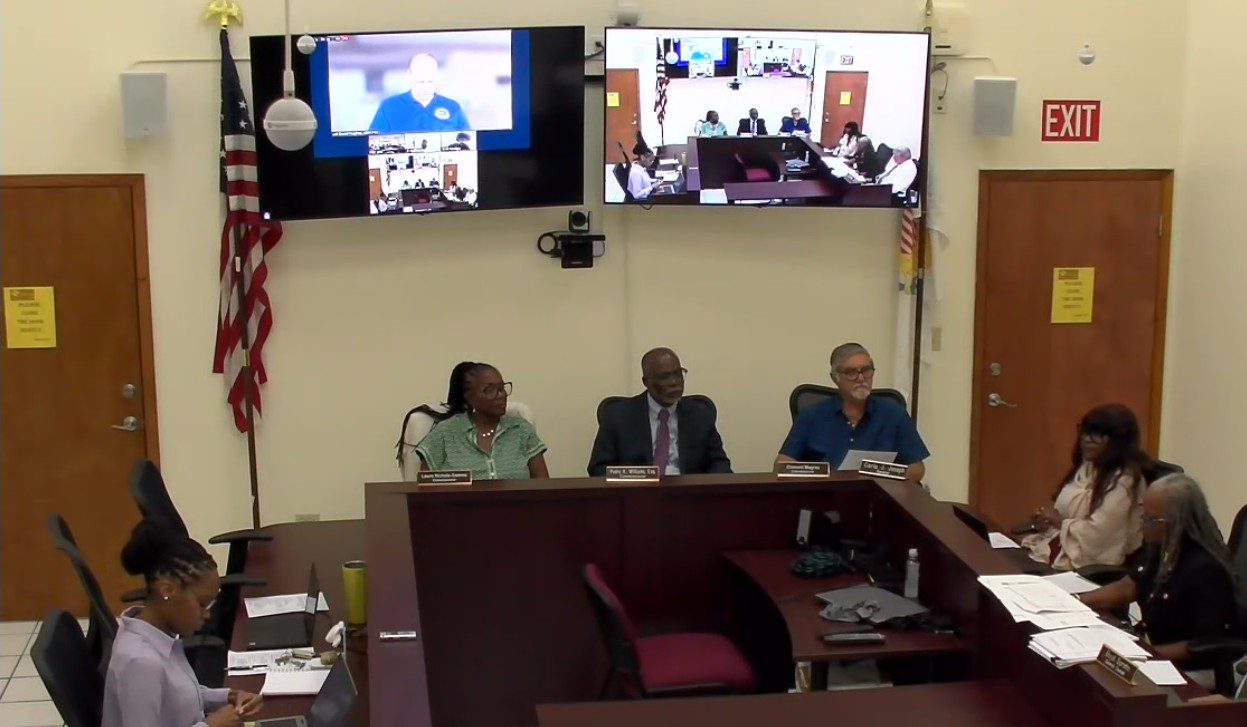
Ratepayers shouldn’t expect their electric bills to go down until June at the earliest. The V.I. Public Services Commission settled with the Water and Power Authority Tuesday and voted to maintain the current Levelized Energy Adjustment Clause charge at a little more than 22 cents per kilowatt-hour until June 30, 2026.
The LEAC is a charge WAPA levies against its customers to cover the cost of fuel needed to provide the territory with electricity. For years, the LEAC rate has been approximately 22.22 cents per kilowatt-hour, and consultants hired by the PSC have repeatedly advocated for lowering it in light of rosy projections of savings following the commissioning of the St. Thomas power plant’s Wartsila generators, which are supposed to be able to run on propane in addition to costlier diesel. In reality, the utility has struggled to run the generators with the cheaper fuel, and the units have been plagued by mechanical issues.
The PSC voted in June to lower the rate to 17 cents per kilowatt-hour. The utility immediately decried the move as a “deliberate, ill-considered decision” and petitioned for reconsideration. On Tuesday, PSC attorney Boyd Sprehn laid out the terms of the settlement agreement, which gives the parties two months to hash out WAPA’s claims of a $147 million deficit resulting from $639 million in LEAC revenues and $766 million in fuel costs from 2021-2025. During a Senate Budget, Appropriations and Finance Committee hearing Monday, WAPA Chief Executive Officer Karl Knight said the utility’s shortfall would have been even greater if not for the $77 million in subsidies from the central government, which declared a state of emergency in April 2024 to help the authority keep the lights on.
Besides the static LEAC rate, Sprehn said Tuesday that “any remaining sum from the now current balance of $147 million will be zeroed out,” he said. “WAPA may accrue additional deferred fuel account claims between now and June 30. WAPA and the PSC staff will meet within 60 days to define acceptable changes and calculations to that deferred fuel balance … and return that to the commission.”
The commission approved the agreement in a 3-2 vote before moving on to an investigation into WAPA’s fuel acquisition process. In July, the utility’s governing board narrowly approved a fuel supply contract with the Puerto Rico-based Empire Gas Company and broke from years of reliance on Vitol. The contract raised eyebrows — including those of the board’s own chair, Maurice Muia, who said the board still had questions about the deal when it came to a vote last month. On Tuesday, Knight told commissioners that Empire “provided the best value from a logistics perspective, a technical perspective, payment terms, as well as pricing.”
Commissioner David Hughes noted that Empire “has no experience in bulk transportation” of liquid petroleum gas.
“They don’t own any ships. They don’t lease any ships. They never have. They run a distribution business out of Puerto Rico, and they’re supplied by third parties,” he said. “I don’t know that that necessarily makes them one of our stronger candidates — although … you’ve been through the field. There are roughly 15 or 16 entities operating in the Caribbean that operate their own ships or operate leased vessels — just seems strange to me that we’re going to depend on someone that has no experience and has never had any experience in that field.”
Knight pushed back on Hughes’s assessment, saying that no one in the region transports LPG in bulk.
“There’s bottled gas that goes up and down the Caribbean, primarily for cooking gas purposes,” he said. “It’s either bullets or it’s bottled. Diageo, for instance, takes on fuel for their power generation — it’s bullets that they use. No one does bulk LPG other than Vitol. They built the market, they built the terminal. There’s not a single other utility in the Caribbean that has a propane terminal and takes on ocean-borne LPG in bulk. That doesn’t exist.”
Hughes noted that Vitol didn’t have ships in the region either and had been contracting regional carriers for the last three and a half years.
“And that carrier is an active entity — with ships in the Caribbean — and was in the list of those companies which you listed as having been solicited for the bid,” he said. “So Vitol doesn’t actually do this business anymore either, but there are companies that do. And I’m just suggesting those companies are fairly qualified to meet this bill, and if they were to come with a lower price, you should consider it.”
Knight suggested that other companies initially played hardball with the utility.
“And then once they realized that we were serious about looking for an alternative supplier, suddenly everyone wanted to have a conversation,” he said. “I look at that as a positive. The next time we put out a solicitation, I expect everyone to sharpen their pencils, and they’ll be ready to actually meet our needs in a way that makes sense for the Water and Power Authority. But at the time, I think they felt the market was cornered, and this was the pricing that the market would produce, and they thought we didn’t have options. We found a solution that works for all the people of the Virgin Islands.”