

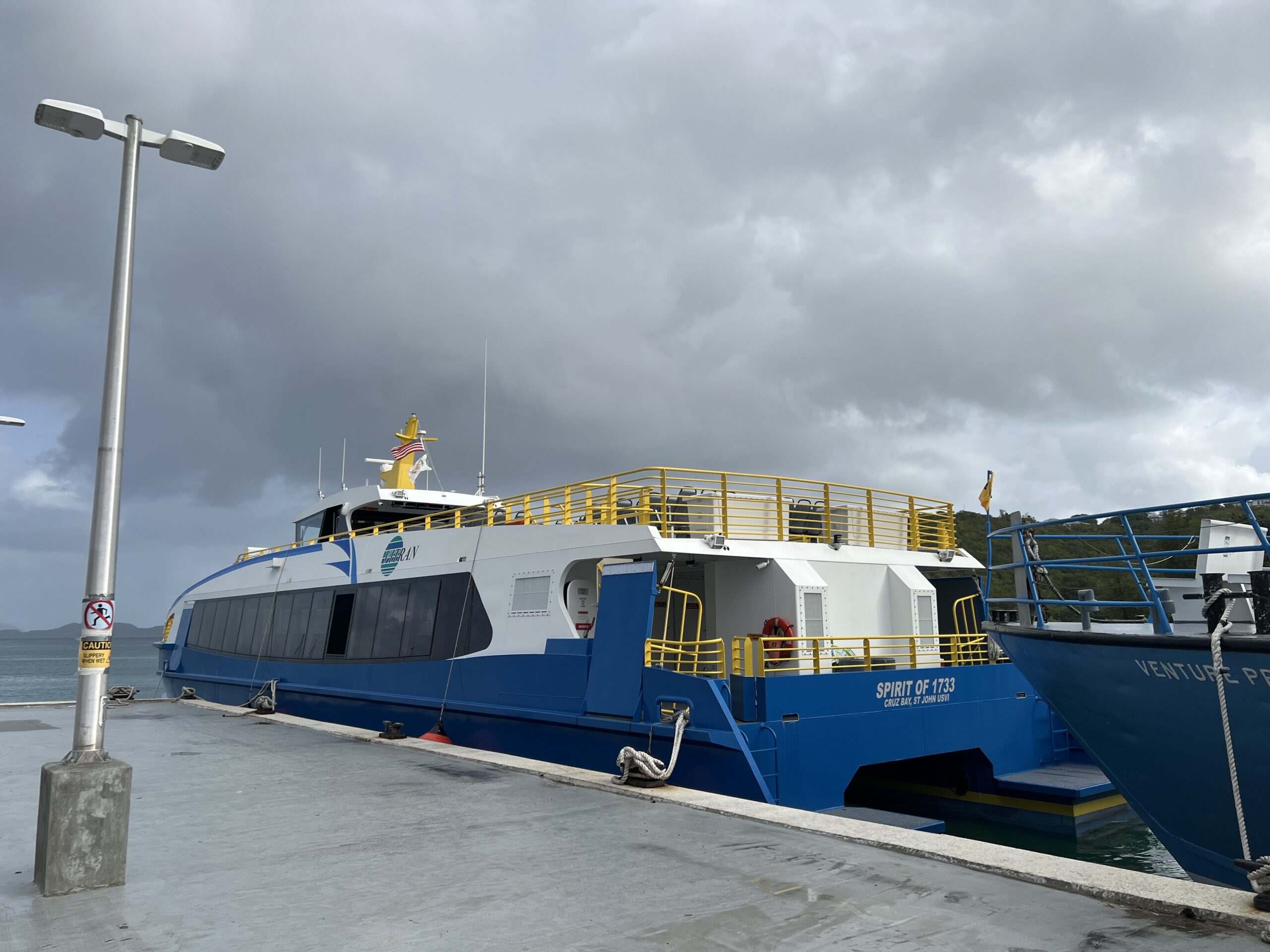
Virgin Islands ferries between St. Thomas and St. John will be allowed to charge $0.66 more per ticket for the next three months to help alleviate costs from the spike in fuel prices, the Public Services Commission voted Tuesday.
The industry had asked for a $0.75 increase in May but the commission, which also oversees rates for the territory’s utilities, briefly considered $0.60 or $0.65 before settling on $0.66. The commission voted to have the increase end after 90 days.
There was some question about how the ferry companies — Varlack Ventures and Transportation Services — arrived at $0.66 but no question about the staggering increase in fuel prices. The ferry companies were paying as much as $7.68 per gallon, officials said.
The fuel relief came as the commission sought to assess and rearrange how the ferries charged passengers. A report drafted in late April suggested the industry may be making more money than allowed. Virgin Islands law allows the companies between 8% and 10% profit, according to the report. On $85 million revenue annually, the companies were collecting $7 million too much, the report said.
Commission chair David Hughes suggested the fuel surcharge could be taken from that $7 million rather than passed on to customers. A sticking point, however, was that the report and its findings had not been officially recognized or accepted by the commission. An attorney for the ferry industry had lodged a last-minute list of objections to the report that the commission did not address Tuesday because commissioners had not been able to read it on short notice.
Ferry operators have long rankled at regulation, a situation not alleviated by the commission’s inquiry into how the operations collect and spend their money. Most recently, the commission sought, and failed, to audit fuel consumption per route, per day, per year in an effort to pinpoint precisely how much money the companies needed to turn a profit between 8% and 10%.
“We have not accomplished the goal of the audit, which was to understand the fuel consumption of the three boats,” Hughes lamented. “We have data integrity issues and this is a big number that needs to be checked.”
The commission was also considering changing how the ferries charged — not just ticket price, but who paid what. There were six classes of ferry rider, Hughes said, each paying a different rate: children, students, senior citizens, adult residents, adult nonresidents, and bulk ticket buyers.
Hughes suggested, once the commission better knew the ferries’ finances, tickets could be made free-for-all children and seniors, and possibly even all local adults as well.
“It’s an opportunity to do something special for the Virgin Islands residents,” he said.
If all Virgin Islanders rode for free, all visitors would have to pay around $11 to cover the lost revenue, he said.
Sen. Carla Joseph, an ex-oficio commissioner, acknowledged she didn’t know how much it cost to put baggage on the ferry, then suggested the rate be raised from $4 to $6, or even $10.