

Editor’s Note — It’s official: Professor Olasee Davis’s decades-long effort to preserve Maroon Country on St. Croix as part of the U.S. Virgin Islands’ Territorial Parks system is now a reality following the purchase of some 2,386 acres of undeveloped forested and coastal land that was under threat of development. The area is so named for the thousands of enslaved laborers from Africa who sought self-liberation by fleeing plantation life and seeking refuge in the remote, inaccessible areas that the Maroon Sanctuary Territorial Park will now protect. Government House confirmed Monday that an official announcement will come later this week.
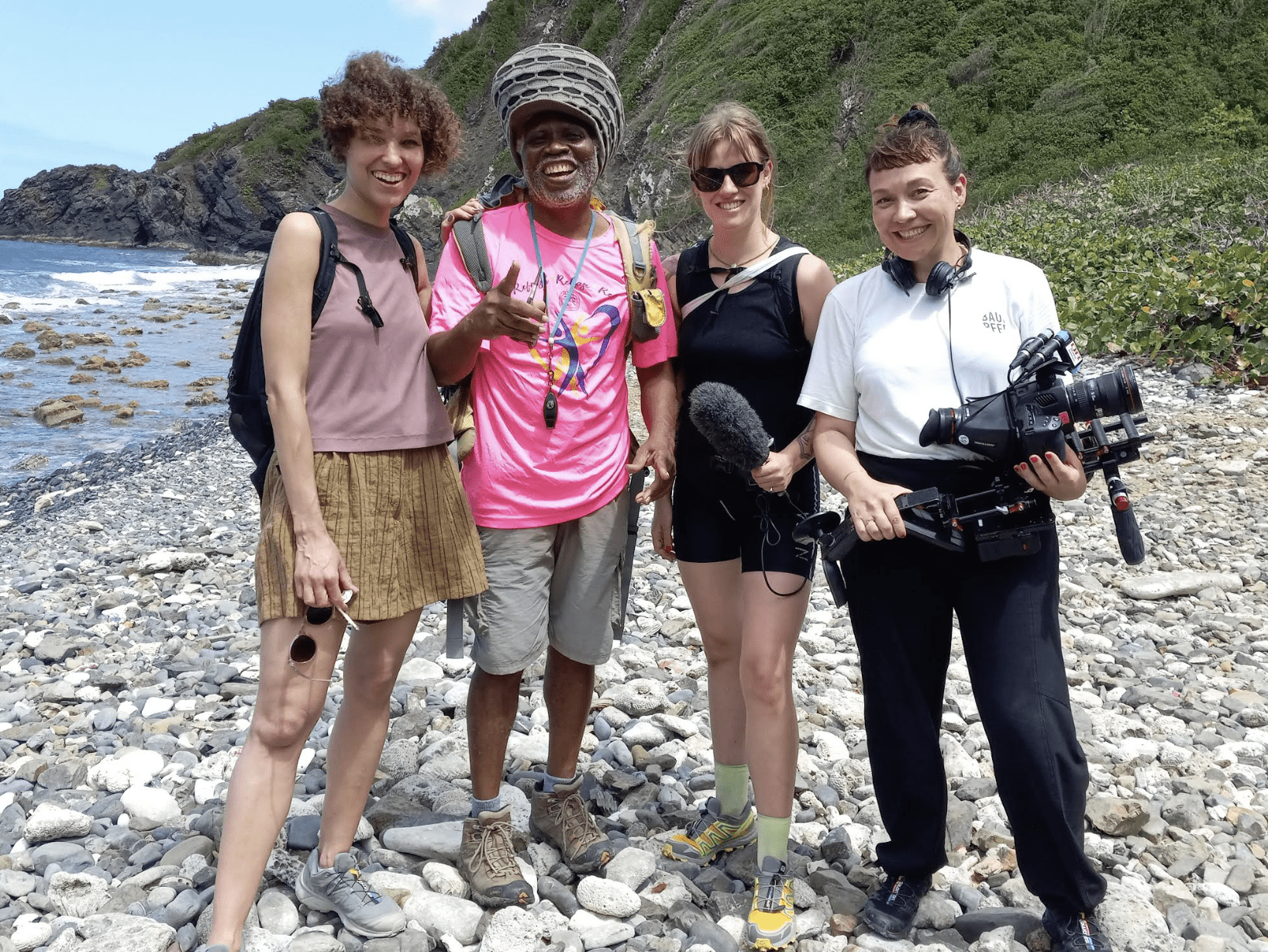
Last spring Anne Fisker Hansen, a Danish journalist who I worked with on a project called “Slave life in the Danish West Indies,” said to me, “Olasee, 2024 would be your year.” I looked at her and blushed, thinking nothing of it. Nevertheless, the “Slave life” project also included Maroon Country on the Northwest A Quarter of St. Croix. I was told by Nola Grace Garrdmand, Hansen, and Michelle, all three who are journalists from Denmark, that I have had followers for years in their home country, by reading my online articles, research, and the social and political stand I have taken to preserve the Great Northwest of St. Croix.
They even mentioned that I have a fanfare club in Denmark rooting for me to protect the Northwest as a territorial park. I was taken aback by their comments because I see myself as an ordinary person who tries to make a difference in my community and the world. The three journalists are part of the Danish National Broadcasting Corporation, which was working on a large historical drama documentary about Denmark’s participation in the transatlantic slave trade and about the life of enslaved Africans and slave owners in the former Danish West Indies colony.
The Danish journalists believe the story should not be told merely from the perspective of the slave traders and slave owners. Their aim is to tell the story from the perspective of the enslaved laborers as well. They believe this part of history has often been neglected in Western historical traditions. The series was broadcast in the spring of this year and was filmed in the Virgin Islands, Ghana, and Denmark.
For 42 years, I have been fighting socially and politically to preserve the Northwest of St. Croix to become a park whether managed by a nonprofit organization, locally or the federal government. As a native conservationist, I wanted to see the Northwest of St. Croix be preserved as a park indefinitely, for the people of the Virgin Islands and our nation. I realized that to protect the area, it takes the power of the pen. That means protesting by writing articles about Maroon Country and conducting scientific research to get support not just locally, but also nationally, and internationally.
There has been countless scientific research conducted in Maroon Country by botanists, anthropologists, historians, foresters, ethnobotanists, archaeologists, and so many other research managers. To make the Northwest known to the Virgin Islands community, I have taken literally thousands upon thousands of people, especially our schoolchildren, there for more than 42 years! People nationally, and internationally, are drawn to learn about the natural, cultural, and marine resources of the area.

The Danish National Broadcasting Corporation that I mentioned earlier is one of many companies I worked with over the years, including our own PBS television station, in educating the world public that the Great Northwest is significant to human history. Also, I have been interviewed by countless magazines over the years locally, nationally, and internationally such as Virgin Islands Pride, National Geographic, Caribbean Travel & Life, Gardenia Fiori, Orti E. Giardini, Islands Destination and Dreams, and American Legacy, just to mention a few, in promoting Maroon Country preservation.
Believe me, I take every opportunity I get to educate the public to protect the Northwest and Northeast central areas of St. Croix, hoping someone will hear my cry in the wilderness of this spiritual, ecological, and sacred landscape of the highlands region of St. Croix. Over the years, community organizations have held conferences, workshops, tours, and utilized other means to promote the protection of Maroon Country.
At the end of the day, however, I often stand alone in fighting to preserve a land where slave gravesites still exist, virgin forests abound, caves beckon, clouds touch the mountaintops during heavy rainfall with flowing streams, tide pools that take your breath away with their geological moon-like rock formations, wildlife that brings the forest alive with the sounds of native and exotic creatures, and the waves of the ocean hit against the rough coastline of a paradise — all of it just waiting on the Northwest of St. Croix to be preserved.
In this journey to preserve part of Virgin Islands heritage, I have fasted many times, cried at times, become depressed at times, and prayed all the time to balance my physical, mental, and spiritual life. Believe me, I had sleepless night at times, worried at times, and wondered if God would ever answer my prayers from a sinner, and one who is imperfect in so many ways. However, when I thought of the heroic spirit of enslaved Africans in the Great Northwest of St. Croix who affirmed freedom and human dignity by flight, struggle, and the creation of temporary refugee communities in the hills, cliffs, forests, and mountains, I became hopeful for the preservation of Maroon Country.
Hope and faith springs eternal. I received an email message from one of my former University of the Virgin Islands students, Caroline Adams Fawkes. She invited me to her pre-commencement breakfast at UVI’s St. Croix campus. She was about to receive an honorary doctorate degree, for which I remain so proud of her. At the same time, I had a very important meeting with government officials in my office. Believe it or not, it was the same day and time of Caroline’s event.
Earlier on, I was told by the government officials by email messages that they had good news for me. At that moment, I knew I couldn’t attend Caroline pre-commencement event. Knowing Caroline, I knew she would understand my dilemma. The government officials went a step further and said, “You can’t die now” and advised me not to tell anyone about the good news until the federal government announced that over 2,000 acres of the Great Northwest on St. Croix will be protected as part of the Virgin Islands Territorial Park along with lands in St. Thomas and St. John!
My heart jumped for joy. This is history. Can you believe it? It is the first time in Virgin Islands history where land of such large acreage on St. Croix will be set aside as a territorial park for the people. I’ve often said to family and friends that whenever the Northwest is protected, I can die in peace. I knew then in my heart that God answered my prayers.
It was the efforts of Melissa Hill, project manager of the Trust for Public Land in Florida, Sarah Haynes and Bruce Wilson, the Trust for Virgin Islands Lands, Kitty Edwards, director of the V.I. Territorial Parks under the Department of Planning and Natural Resources, Gerard Frandelle, executive director of Crucian Heritage and Nature Tourism, Celeste Jarvis, director of Nature Conservancy, and others including colleagues from UVI, Toni Thomas and myself who submitted a grant proposal to NOAA for land acquisition of Maroon Country on St. Croix. We were awarded the funds. Anne was right: 2024 was the year of Maroon Country preservation on St. Croix.
— Olasee Davis is a bush professor who lectures and writes about the culture, history, ecology and environment of the Virgin Islands when he is not leading hiking tours of the wild places and spaces of St. Croix and beyond.
Following are links to previous editorials by Olasee Davis, advocating for Maroon Country to be included as part of the Territorial Parks system:
Op-Ed: It is Beyond Time to Make St. Croix’s Maroon Country a Territorial Park
Open Forum: St. Croix’s Maroon Country Should Be a Territorial Park System Priority
Open Forum: Estate Annaly Must be Included in Maroon Territorial Park
Open Forum: A Maroon Territorial Park is Not an Option But a Must