

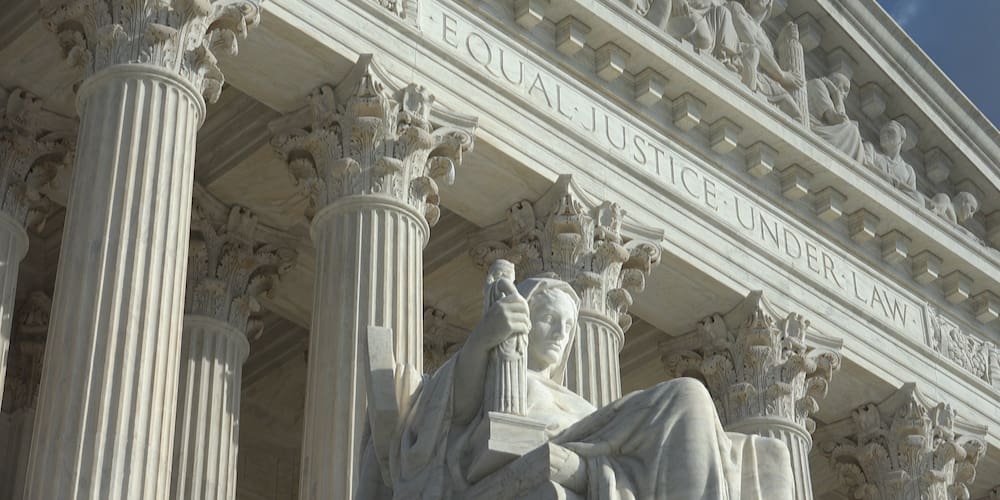
It seems America is haunted by a new Boogie Man, one that has the nation on edge as the Supreme Court prepares to take center stage in early 2026. The justices are set to deliberate the president’s Jan. 20 executive order, a bold move to unravel birthright citizenship — a tradition that has long opened America’s doors to newborns from every walk of life. This drama is entwined with Project 2025, a blueprint for sweeping executive actions and policies designed to reshape the federal government and rewrite the nation’s legal DNA.
The court’s decision could either support or destroy these goals, changing what it means to be born American. The boldness of this administration is hard to ignore. What drives this strong determination? Who is being targeted by this ongoing effort? History shows this is not the first time a president has fought against the 14th Amendment. President Andrew Johnson fought hard against the amendment, especially its promise of citizenship and protection for people who had been enslaved. He blocked Reconstruction laws meant to protect the rights of freed people, but Congress overruled him.
The 14th Amendment, supported by Radical Republicans like John Bingham of Ohio, was created to fix one of the Supreme Court’s worst decisions, the 1857 Dred Scott case, which took away citizenship from Black Americans. Dred Scott’s fight for freedom, based on his years in free states, was denied by a court that said African Americans, whether enslaved or free, could never be citizens or ask for justice in federal court.
Will the Supreme Court meet this challenge bravely, or will it fade into history? The justices have agreed to decide whether the president’s plan to end automatic birthright citizenship for children born in the U.S. goes against the Constitution.
Let’s be clear that the Republican Bingham is also credited for framing the first section of the 14th Amendment that reads, “All persons born or naturalized in the United States, and subject to the jurisdiction thereof, are citizens of the United States and of the State wherein they reside. No State shall make or enforce any law which shall abridge the privileges or immunities of citizens of the United States; nor shall any State deprive any person of life, liberty, or property, without due process of law; nor deny to any person within its jurisdiction the equal protection of the laws.”
This part of the amendment is the core of American values: it guarantees citizenship, fair treatment under the law, and equal protection for everyone. Bingham, who strongly opposed slavery, worked hard to win rights for freed slaves. Now, we must ask: is this administration repeating President Andrew Johnson’s refusal to respect these promises for everyone born or made a citizen in the United States, including those who were once enslaved? Johnson’s refusal to support these federal protections for Black Americans was obvious to everyone.
Johnson was not the only president to fight against protections for Black Americans under the 14th Amendment. Democratic President James Buchanan supported the pro-slavery Dred Scott decision, taking away citizenship and rights from Black Americans. Franklin Pierce, another Democrat, fought against efforts to end slavery and against federal protections for Black rights. Even earlier, presidents like James K. Polk and Millard Fillmore, from the Republican and Whig parties, wanted to spread slavery into new areas and tried to stop any efforts to limit it.
The 14th Amendment is a broad promise, giving birthright citizenship to everyone born or made a citizen in the United States and welcoming African Americans and many others into the country. Created during the Civil War and the fight to end slavery, it was proposed in 1866 and approved two years later, giving hope to newly freed slaves who wanted to be part of America. The Citizenship Clause says that anyone born in the U.S. is an American citizen, regardless of their parents’ immigration status.
The 14th Amendment serves as a protection, preventing anyone from losing their life, freedom, or property without due process and requiring equal treatment under the law. It also stopped former Confederate supporters from holding public office. So, who is being targeted today?
The United States is one of about 30 countries that automatically grant citizenship to nearly everyone born within their borders. In 1898, the Supreme Court decided in favor of Wong Kim Ark, who was born in California to Chinese parents. The Court’s 6-2 ruling rejected the government’s argument that he was not a citizen, and a judge explained that the 14th Amendment supports the long-standing rule that all children born within the U.S. are citizens by birth.
Under the order, which has never gone into effect, people born in the United States would not be automatically entitled to citizenship if their parents are in this country either illegally or temporarily. The challengers argue that the order conflicts with both the Constitution’s text and the court’s longstanding case law.
Immigration status has never been one of those exceptions. Undocumented immigrants, like all other noncitizens in the United States, live under the full reach of U.S. law. They pay taxes, work, attend school, and can be arrested, prosecuted, or removed. The very fact that the government can enforce immigration laws against them shows they are indeed “subject to the jurisdiction” of the United States. Still, the 14th Amendment is not set in stone. If it were, why would the Supreme Court consider the president’s challenge to birthright citizenship? The Constitution provides a path for change through its formal amendment process. Any part of the document, even existing amendments, can be altered. This requires a two-thirds vote in both the House and Senate, or a national constitutional convention called by two-thirds of state legislatures. The process is demanding, as laid out in Article V, which details how amendments are proposed and must be ratified before becoming law.
Sources:
Amy Howe, “Supreme Court agrees to hear Trump’s challenge to birthright citizenship, https://www.scotusblog.com/2025/12/supreme-court-agrees-to-hear-trumps-challenge-to-birthright-citizenship/,
“Donald Trump’s Policies Target Black Americans,”https://benniethompson.house.gov/donald-trumps-policies-target-black-americans,
“Protecting the Meaning and Value of American Citizenship,” https://www.whitehouse.gov/presidential-actions/2025/01/protecting-the-meaning-and-value-of-american-citizenship/;
“US Supreme Court to consider Trump’s bid to end birthright citizenship,” https://www.aljazeera.com/news/2025/12/5/us-supreme-court-to-consider-trumps-bid-to-end-birthright-citizenship.
— Otis D. Alexander, PhD, a retired music teacher at St. Croix Central High School, has taught at the Sprauve and Guy Benjamin schools on St. John. He is an alum of the Harvard Graduate School of Education Leadership for Academic Librarians. He can be reached at od.alex1972@gmail.com.
Editor’s Note: Opinion articles do not represent the views of the Virgin Islands Source newsroom and are the sole expressed opinion of the writer. Submissions can be made to visource@gmail.com.