

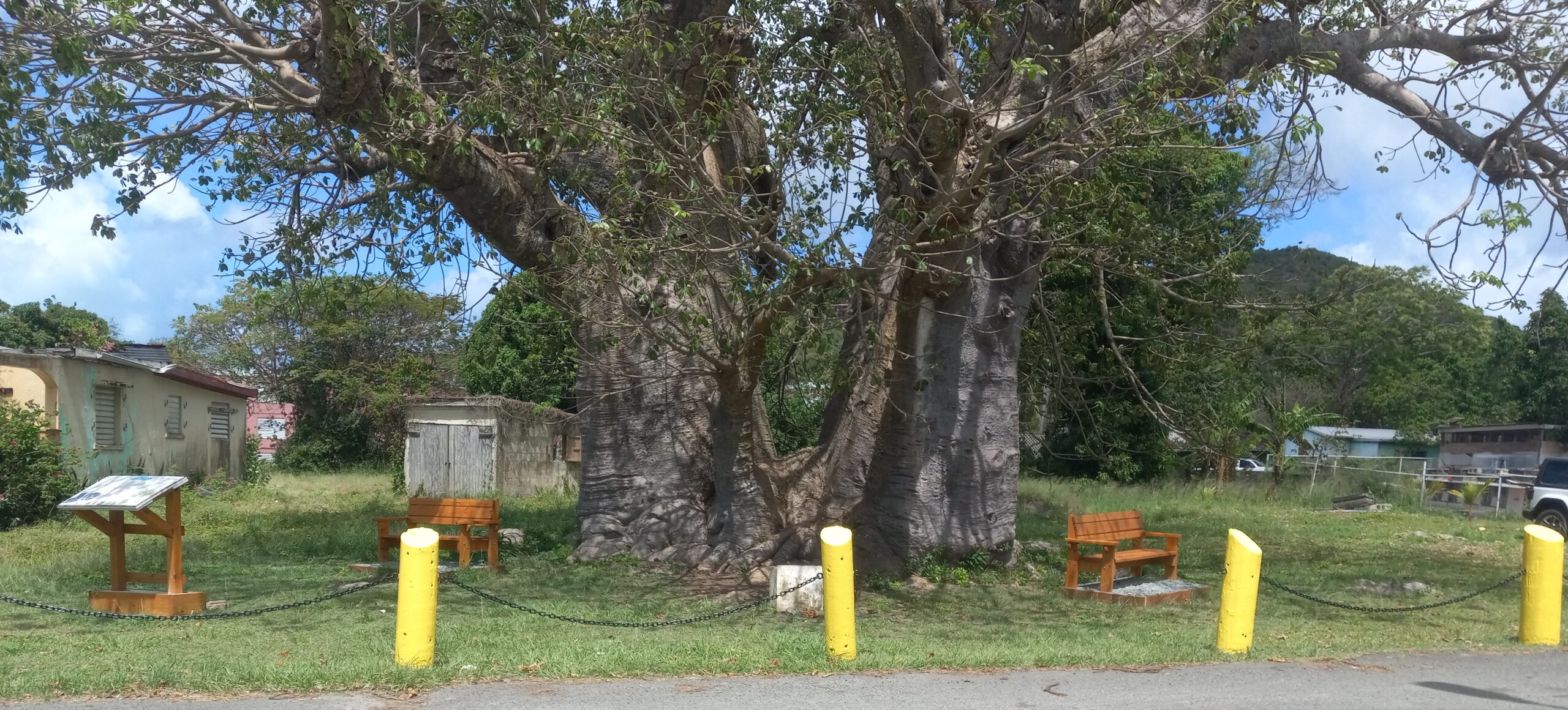
In 2017, the historic baobab tree in Estate Grove Place on St. Croix was impacted by Hurricane Maria. Branches were hanging off the tree due to the violent winds of the storm. In other words, the tree looked pretty beat-up. As my usual self, I wrote a protest article to the local newspaper to make the community aware of the need to save the Grove Place baobab tree. How much time, would I say it to myself — as a community, we have no patriotism when it comes to the preservation and protection of our natural and cultural resources in the Virgin Islands.
Why should I care about the Virgin Islands’ natural and cultural resources? As a people, very few of us show interest in our natural surroundings. To be frank, we trash these islands with garbage all over the place, even in remote areas of the islands. It hurts me when I see our streets and roadsides trashed with garbage. As a people, we have become so accustomed to garbage and abandoned vehicles in bushes or along the roadsides, that we ourselves don’t realize that we are walking around in our own filth.
About trash in the Virgin Islands, it ended up in a book entitled, “The Remarkable Baobab,” by Thomas Pakenham, one of the world’s great photographers of trees. In 2014, I worked with Mr. Pakenham as he prepared to write about the baobab trees in the Virgin Islands, especially the trees on St. Croix. I felt bad when I took him to the baobab tree in Grove Place and saw the trash and bush surrounding this historic tree. What can I say?
It is not what I say, but what the researcher of trees said when he was taking photos of the Grove Place historic baobab tree. “But I was astonished to find that today this heroic survivor is largely ignored. Once it was a jumbie tree and a symbol of suffering and resistance. Now, apart from Olasee and his friends, no one seemed to give a damn,” wrote Pakenham. He went on and said in his book of the 300-year-old baobab tree in Grove Place, “The place was used as a rubbish dump, and the tree itself was half hidden by thorn bushes.”
In 2003, the late Dr. Robert W. Nicholls and colleagues of mine from the University of the Virgin Islands submitted a nominating paper for the Estate Grove Place baobab tree, to the National Register of Historic Trees. He and I took it upon ourselves that the Grove Place baobab tree is valuable enough to be a national historic tree among our nation’s historic trees and the world. For about 300 years, the tree witnessed history from enslaved laborers, the plantation workers, Emancipation of 1848, the 1878 Fireburn with sugarcane workers, and in 1915 when the labor union was established — all under the Grove Place baobab tree.
Every year, we celebrate D. Hamilton Jackson on Nov. 1 to honor Jackson for the freedom of the press for us Virgin Islanders. It was Oct. 15, 1915 when an issue of The Herald was published and a bull was slaughtered and roasted, and the public feasted on it under the very same baobab tree in Grove Place.
Nevertheless, we got a letter back from American Forests on whether the baobab tree in Grove Place could be one of the nation’s historic trees. Here are a few sentences from the American Forests National Register of Historic Trees in reference to the baobab tree in Grove Place:
“Once that is finalized, forestry personnel will physically visit the tree, verify the species, and take official measurements. Photography will be obtained based on the publisher’s instructions. Thank you for taking your time to make us aware of this notable tree, Sincerely Sheila T. Pursley, Project Coordinator, National Register of Historic Trees.”
As a result of the late Dr. Nicholls and my effort, the Grove Place baobab tree was listed as a National Register of Historic Trees in our nation and the Virgin Islands. It is the only tree that I know of in the Virgin Islands to be on the National Register of Historic Trees.
In late fall of 2025, a colleague, Vanessa Forbes from the School of Agriculture, University of the Virgin Islands contacted me about a gentleman who’d contacted her from Grove Place, concerned about the baobab tree’s health. I got in contact with the gentleman. From there, I contacted Alma Winkfield, vice president of the Virgin Islands Trail Alliance of which I am a member, to consider making the Grove Place baobab a tree project. Then, we got in contact with the landowner, Ms. Magdalene Edney. With her permission, we told her the V.I. Trail Alliance would remove the termites and the bees from this historic tree. We also told her that we would like to install benches and a sign giving the botanical history and cultural history of the Grove Place baobab tree.
Believe me, Ms. Edney was all excited about the tree project. All expenses of the baobab tree project in Grove Place were paid for by the Virgin Islands Trail Alliance organization, to install the benches, signage and painting of poles along the road near the tree. However, my heart was broken when I learned that Ms. Edney passed away. She never got a chance to see the baobab tree project completed. The signage and benches under the historic baobab tree in Grove Place are a tribute to Ms. Magdalene Edney and her family.
The tree project signage gives recognition to all who contributed to make it possible to save the Grove Place baobab tree. It is projects like this that give me hope and comfort to know that there are still people in the Virgin Islands’ community that care for the natural and cultural resources of these islands.
— Olasee Davis is a bush professor who lectures and writes about the culture, history, ecology and environment of the Virgin Islands when he is not leading hiking tours of the wild places and spaces of St. Croix and beyond.
Editor’s Note: Opinion articles do not represent the views of the Virgin Islands Source newsroom and are the sole expressed opinion of the writer. Submissions can be made to visource@gmail.com.