


The other day, I got an email message from a good friend of mine, Brigitte Berry, a rare native Virgin Islander who loves these islands’ wildlife and environment. She sent me a photo of a native reptile most people in the Virgin Islands never encounter or have heard of. It was a legless lizard (Amhisbaena fenestrata) looking more like the blind snake (Typhlops richardii). This legless creature is a burrower. It is only seen when digging into the ground, turning over stones or litter.

They are easily distinguished from Typhlops richardii, the blind snake, by their beige or pink color, and the rings of scales around their body. They are also called Virgin Islands worm lizard. According to biologists, their legs may have disappeared due to the subterranean environment they have lived in. Although they are less than 10 inches long and ¼ inch in diameter, they are voracious predators. Their bite can be painful, sometimes drawing blood or removing a piece of your skin if you handled them.
The generic name of Amphisbaena pretty much sums it up. It derives from the Greek words “bainin” meaning to go and “amphs” meaning “both ways.” In other words, the legless lizard has the ability to move forward and backward, both on the surface of the ground and in their burrows. The diet of the legless or worm lizard in general is composed of cockroaches, termites, ants, beetle larvae, and other sorts of body insects, depending on the species of Amphisbaena.
The legless worm lizard primarily is found in forest habitats, underground, but also may be seen on the surface of the ground, especially after heavy rainfalls. They are native to the Virgin Islands, Tortola, Great Camanoe, Virgin Gorda, Puerto Rico, Culebra, and Vieques. Nevertheless, I heard for donkey years that the small Indian mongoose (Herpestes edwardsii) was brought to the Virgin Islands to kill snakes. This also includes any reptile like the legless worm lizard. However, this is a myth.
In 1884, the mongoose was introduced to St. Croix to control the rats in the sugarcane fields not the snakes. Of course, the mongoose had a major impact on the wildlife population of the Virgin Islands, in particular birds, as well as the agricultural industry, specifically poultry farms. We have five native snake species in the Virgin Islands. This doesn’t include the invasive red tail Boa constrictor, which is a recently introduced species on St. Croix that is impacting our wildlife population and putting fear in people.
The blind snakes are generally known as worm snakes, or some people referred to them as garden snakes. These small snakes are about 5 to 10 inches overall. They burrow into the ground. They are gray or brown above and cream below in color. Their tongues are forked with a smooth scale around their bodies that allows them to travel through the soil. Believe me, they are good for your garden, loosening up the soil for plant growth.
They have reduced small dark spot eyes under the scales of their head. Their mouth is well behind and below the tip of the snout. Their bodies and tail are nearly cylindrical, ending the tail with a sharp point. These reptiles eat ants, termites, and other small insects. The blind snakes are native to Puerto Rico and the Virgin Islands, spending most of their lives underground. They are also found mostly in other tropical regions of the world.
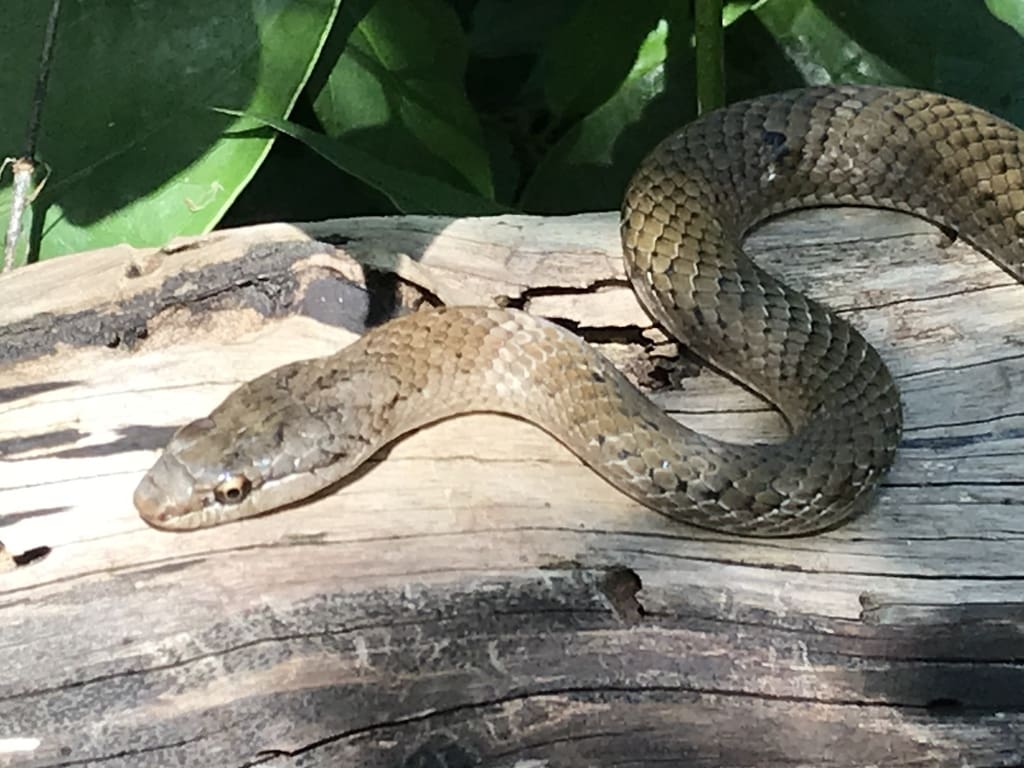
The Puerto Rican racer (Borikenophis portoricensis or Alsophis portoricensis) is another native species snake and endemic to Puerto Rico and the U.S. and British Virgin Islands. These snakes can grow to be 2½ to 3 feet long. Most Puerto Rican Racer snakes are gray, brown, or olive color above, while some have longitudinal stripes. However, the underside of the snake is white, sometimes with dark spots or stripes on the sides. Keep in mind, we don’t have any native or exotic snakes in the Virgin Islands that are poisonous.
The Puerto Rico racer snakes are believed to be rare or extinct on larger islands, but on small islands like Water Island, Hassel Island, Greater and Smaller St. James, and several other cays, inlets and small islands surrounding St. Thomas and St. John, these replies are moderately common. These snakes hunt in the daylight. They are very quick and usually bite if caught. The bites can bleed, but in humans its effect ranges from mild swelling to immobilization and to a severe numbness that may last up to a month. If they are cornered, they will raise their head and can flatten their neck like a cobra.
The primary food source for Puerto Rican racers are frogs and lizards, particularly Anoils species. They also are known to consume fish and freshwater crabs. These snakes are found in a variety of habitats, such as woodlands, rocky areas, coastal forests, and in forest leaf litter.
The Arrhyton exiguous is another native snake to Puerto Rico, St. Thomas, St. John, Culebra, Tortola, and Virgin Gorda. It is a small snake basically found around walls, in moist litter, under rocks, and in other similar places of habitat. These snakes are harmless. The upper parts of their bodies are brown with a darker stripe running down the side from behind their eye. Their bellies are light brown or white, with dark spots on either side of each ventral scute. These snakes can get over a foot long, while most of them range from 6 to 10 inches long. They eat small lizards, slugs, and insects.
Another snake, Alsophis portoricensis, is very rare. It is endemic to St. Croix. In 1972, Dr. Charles Leck found some eggs on the east end of St. Croix. Their habitat is xenic forest. This endemic snake of St. Croix is probably extinct and has not been recorded in over 100 years. Probable causes are the introduction of the mongoose and deforestation of its habitat. This snake was also recorded in 1898 on the island of Green Key off the northeast coast of St. Croix. It was known as St. Croix racer or St. Croix tree snake.
The Virgin Islands Tree Boa (Chilabothrus granti) is native to the British and U.S. Virgin Islands and Mona Island between the island of Puerto Rico and Hispaniola. It is an endangered species protected by federal and local laws. It is the largest native snake in the Virgin Islands at 3 or 4 feet long.

Another snake you should know is the Corn snake (Pantherophis guttatus). They are not native to the Virgin Islands, but they have been introduced to the Caribbean including the Virgin Islands. These snakes are invasive species and native to the southeastern United States. The Corn snake is known to carry a parasite called Crytosporidium, which can infect domestic and native mammals, as well as humans causing diarrheal disease. I didn’t intend to talk aboutsnakes, but since the legless lizard looks like the blind snake, I say why not educate my beloved public about snakes in the Virgin Islands.
— Olasee Davis is a bush professor who lectures and writes about the culture, history, ecology and environment of the Virgin Islands when he is not leading hiking tours of the wild places and spaces of St. Croix and beyond.