

 Virgin Islands at a Crossroads is a forum focused on modernizing the Territory. This series advances Project Meridian Gateway, a plan to make the United States Virgin Islands a sovereign Digital Harbor for the AI economy, built on resilient power, trusted connectivity, and execution.
In 1905, Sarah Breedlove was a washerwoman earning $1.50 a day. By 1919, she was Madam C.J. Walker, America’s first female self-made millionaire. She did not inherit land. She did not receive a grant. She did not wait for a corporate savior.
Walker saw a need in her own community and built a business to meet it. But her real breakthrough was not just a product. It was an ownership system. She trained thousands of “Walker Agents,” Black women who earned income, learned business discipline, and circulated wealth through their households.
As we observe Black History Month, the Virgin Islands has to answer a difficult question. In the AI economy, will we show up as workers and consumers, or owners?
Because the AI economy is physical. It runs on facilities that must operate 24/7, and those facilities run on contracts: cooling, electrical maintenance, water systems, logistics, food service, and security. Contracts are where long-term wealth lives.
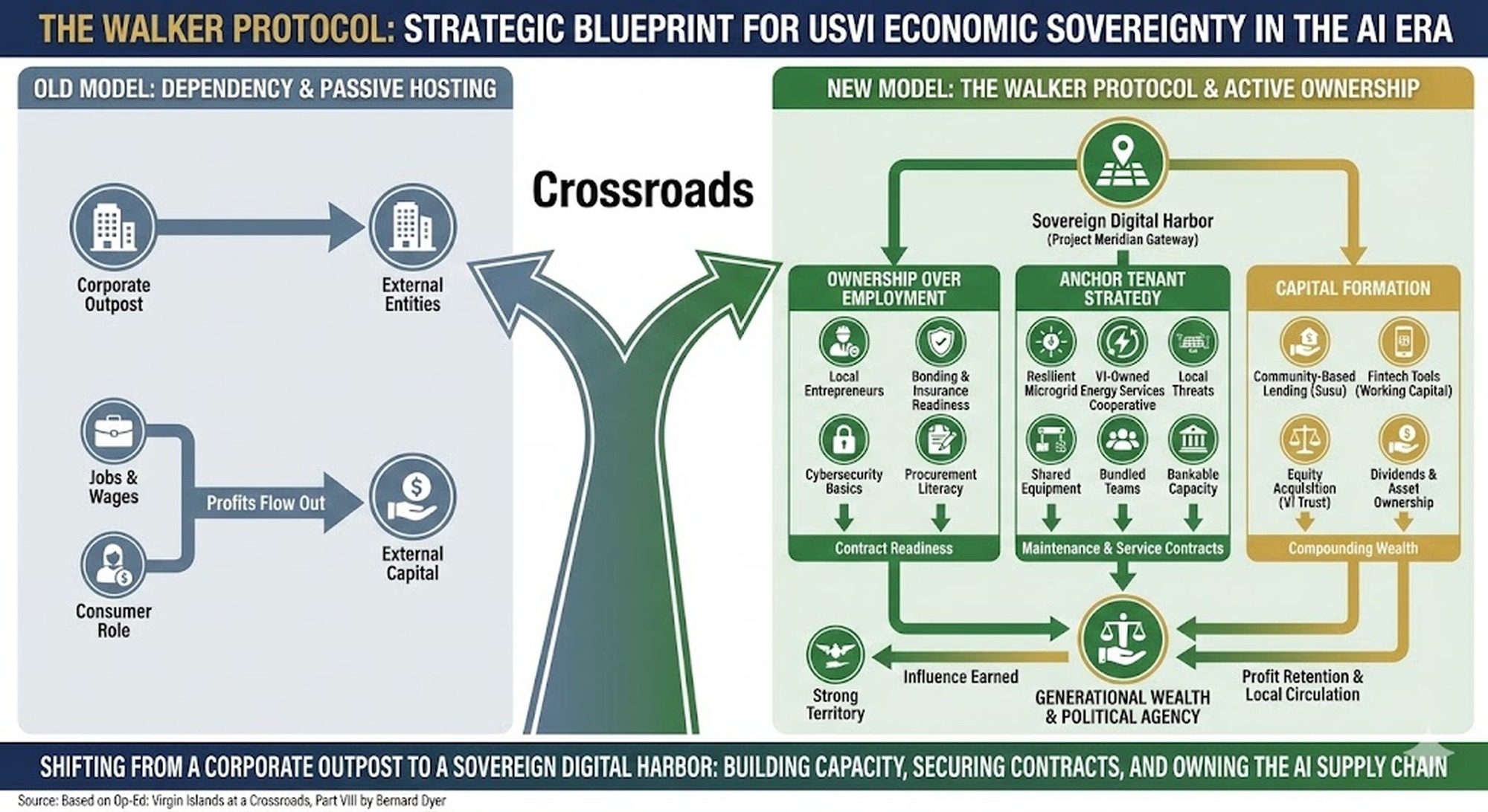
For too long, our development strategy has leaned on a corporate outpost model. We entice outside entities, celebrate jobs, and then watch profits flow out. That is dependency. If we want a different outcome, we have to build a different model on purpose.
If we are serious about Project Meridian Gateway and positioning the U.S. Virgin Islands as an AI-era hub, we should apply the Madam Walker philosophy to industrial strategy. I call it the Walker Protocol.
Ownership Over Employment
The Walker Protocol starts with a mindset shift: from job creation to wealth creation.
When a hyperscale data center is built in a future Digital Free Trade Zone, the headlines will focus on construction. But the durable wealth is in the thirty-year operating ecosystem: the service contracts and procurement streams that keep that facility running.
A 24/7 operation runs on checklists, audits, redundancy, and vendors who show up on time. If we do not build the Virgin Islands’ capacity to meet those standards, the contracts will default to mainland firms. They will capture the margins and leave Virgin Islanders competing for entry-level wages in an economy operating on our own land.
So the Walker Protocol is a preparation path. We must incubate, credential, and scale local businesses to meet zero-tolerance requirements. We need a “Walker Agent” strategy for the AI supply chain: pre-qualified Virgin Islands vendors ready to deploy when anchor tenants arrive.
That requires a policy upgrade. Our economic and innovation institutions must broaden their focus beyond recruiting external capital to actively equipping local entrepreneurs to compete and win. That means targeted certifications, bonding and insurance readiness, safety compliance, cybersecurity basics, and procurement literacy. Ownership is earned through capability.
This requires a playbook built around reality. Start with the standards: train and certify what operators actually require. Then make firms contract-ready: documentation, incident reporting, insurance, and bonding capacity. Where a single small vendor cannot cover a 24/7 operation, bundle teams so they can bid as one and provide reliable coverage. When the first contracts are won, reinvest. Capability has to compound.
Here is what that could look like. A local HVAC contractor on St. Croix should not be limited to “fixing AC.” With the right credentials and vendor readiness support, that firm can provide precision cooling maintenance. A local logistics operator can become a compliant partner for controlled deliveries and fleet operations tied to high-value equipment.
The Anchor Tenant Strategy
Madam Walker understood another principle: you need a strong product to anchor the ecosystem. For us, that anchor is power. No AI infrastructure happens without continuity-grade electricity. That is why the Sovereign Energy Product matters: a resilient microgrid in the South Shore Zone that can deliver reliable power.
Instead of outsourcing the work that keeps that grid running, we should build a Virgin Islands-owned energy services cooperative. This structure would allow independent technicians and small firms to pool resources, share equipment, meet bonding requirements, and bid on major contracts as one unit. It turns scattered talent into bankable capacity and keeps profit in Virgin Islands households.
Procurement should be structured to expand participation by Virgin Islands-owned enterprises that meet technical and compliance requirements, supported by mentorship and partnership pathways that transfer know-how and build track records. Standards remain non-negotiable, while capacity and ownership are deliberately built and retained inside the Territory.
Capital Formation for the Community
Walker taught a final lesson: capital is built, then compounded. Communities without capital cannot scale.
In the Virgin Islands, too many capable businesses stay small because financing treats them as high-risk. The Walker Protocol calls for modernizing our financial architecture so local firms can compete for twenty-first-century contracts.
We should explore regulated community-based lending inspired by susu traditions, alongside fintech tools that provide working capital and equipment financing. If a firm is ready to win a contract but cannot buy tools, secure a vehicle, or meet payroll while waiting on invoice cycles, we have a gap we must solve.
Just as important, we need an investment vehicle that allows Virgin Islanders, at home and in the diaspora, to acquire equity stakes in critical projects. Imagine clean-energy assets powering a data center being partially owned by a Virgin Islands trust, generating dividends for local households. That is how infrastructure becomes generational wealth.
Economic Rights are Civil Rights
Madam C.J. Walker did not treat wealth as a trophy. She used it to fund justice because she understood a hard truth: political agency is downstream from economic power.
The Virgin Islands is often forced to fight for relevance in Washington. But influence is earned. A Territory that possesses energy, controls service contracts, and holds ownership in its digital infrastructure negotiates from strength.
We have reached a generational crossroads. One path keeps us as passive hosts for external technology, grateful for wages while wealth flows away. The other path, the path of Madam Walker, calls us to become architects and owners of our destiny.
Let us stop looking for a savior. Let us build our own empire.
Read the first seven parts of the series here:
Op-ed: Virgin Islands at a Crossroads: Act Now or Miss the Next Global Economic Wave
— Bernard Dyer is a veteran technologist and co-host of WSTX AM 970’s Community Digest radio program. He writes the Virgin Islands at a Crossroads series to challenge the status quo and design a sovereign, modern future for the next generation.
Editor’s Note: Opinion articles do not represent the views of the Virgin Islands Source newsroom and are the sole expressed opinion of the writer. Submissions can be made to visource@gmail.com.